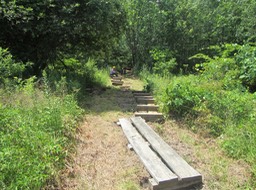
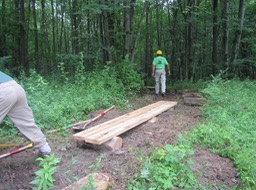
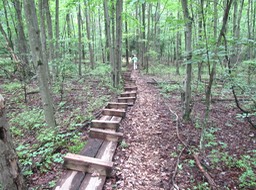
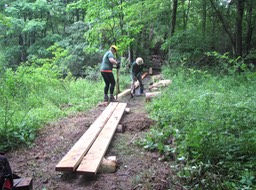
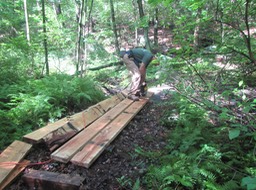
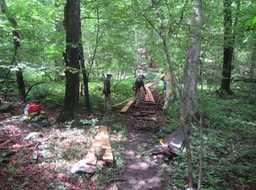
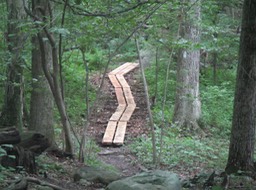
We have left Black Mt. for a little while and will return later in the year, but for now we are on another section of the Appalachian Trail in Kloiber Field refurbishing some old and installing some new bog bridging. Kloiber Field is west of W. Mombasha Rd. in Monroe NY. There will be no high-line nor rope-puller moving big rocks on this project. Here we will be replacing old and decayed bog bridge supports and planking and adding an additional 130 feet of new bog bridging A bog bridge is a form of puncheon having a single or double-plank tread surface resting directly on supports or sleepers. We define bog bridges as a series of connected, short-span bridges close to the ground where the plank of the bog bridge rests on supports or sleepers. A sleeper is placed in a shallow trench at right angles to the trail centerline. A second sleeper is prepared and placed in another trench 3 to 4 feet away. The plank is nailed to the sleepers with two 6” 60-penny galvanized nails driven through previously drilled pilot holes.
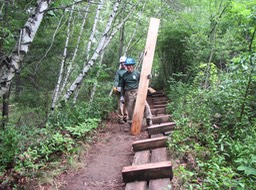
We are in Kloiber Field now because we could only work here when the ground was as dry as it was going to get. Buy definition bog bridging is a foot bridge over areas that are normally wet, but at times can be dryish. We were waiting for this dryish time to work on the bog bridging. The current bridging was constructed using 6” x 6” PT lumber for the supports or sleepers and oak boards for the planking. We will be using 12” round Black Locust logs for the supports and two 6” x 2” rough hewn Black Locust planks. Black Locust is a plentiful renewable resource that is well suited for all outdoor wood uses. Naturally occurring flavonoids preserve the wood and keep it durable. Black Locust is a safe, environmentally friendly alternative to Pressure Treated and Tropical Hardwoods, is chemical free and regrows rapidly. Above all Black Locust is one of the hardest and most structurally sound species of wood available.
A few of us visited the site a week before to brush cut a path and 2 staging areas. This area is covered with poison ivy, buy trimming the trail back we hoped to minimize our crews exposure to the nasty weed.
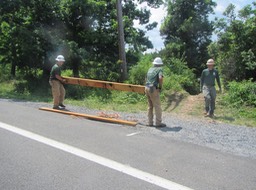
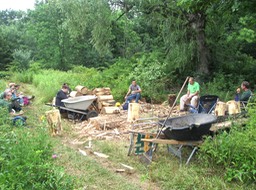
Our weekend started by waiting for our wood supply to be delivered. The rough hewn logs (85 pc. 12” round by 3’ long) were delivered first then quickly followed by the planking, about 95 planks. Our first task was to move all that wood off the road, so with a small crew on a very hot day we moved it into our 2 staging areas. One for the planking and the other for the support logs. On Saturday we had a larger crew so a few of us went to work stripping the bark off the logs while the rest of the crew started disassembling the old bridging, digging new holes or trenches for the supports and moving the now peeled support logs and planking into place. Peeling the bark is important because even though Black Locust is durable, removing the bark removes the areas that wood destroying insects could inhabit. There was a lot of bark to peel, 85 pc, 12” dia. x 3’ long, equals about 255 linear feet of tree trunk or to put it another way about 800 sq, ft. of bark to be removed. Using a drawknife to remove the bark was the easiest and fastest way to accomplish the task and Russ showed us all how it’s done. Digging trenches for the support logs took a lot of effort. The ground was made up of thick heavy clay and plenty of roots. Because the clay was so thick and heavy, you were cutting it rather than digging it. By late Saturday afternoon we had our first bog bridge set in place but wouldn’t be securing the planks until tomorrow when we had our new generator on site and could drill the needed pilot holes before nailing them in place. On Sunday we had another small crew. We moved the generator et al to where we needed it and began to secure the planks to the supports. Where we are reusing the old supports we only had to drill a pilot hole in the new planking but where we used the Black Locust support logs, we had to pre-drill them as well. With all the prep work accomplished on Friday and Saturday we were able to complete several sections of bridging before the end of the weekend.
This bog bridging project is expected to take us a few more outings to complete, so come on out and join in.
Like most of the Appalachian Trail, it is always evolving and changing. Work crews, like LDTC, all along the A.T. constantly relocate and rehabilitate portions of the trail to protect nature and to enhance the Appalachian Trail hiking experience. This particular bog-bridge replacement project was requested because the bridging in this area is dangerous and in serious need of repair. New sections are needed to extend the walkway past muddy areas.
This project will take a lot of effort and as always, it will all done by volunteers.
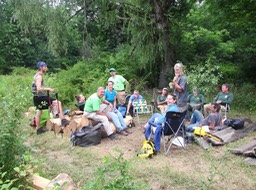
Speaking of volunteers, not everyone could make it all 3 days and that’s OK with us. Some volunteers came for 3 days some for 2 and others could only make it to 1. Don’t feel that you have to commit to the entire weekend, any help is appreciated and being a volunteer you can come and go as you see fit.
During this 3 day work trip. the weather was not so great. Friday was very hot, Saturday a little wet Sunday a lot better. Lots of sun, a little hot, low humidity, a light breeze and no rain.
If this looks like the kind of activity you want to be part of, please come on out and join in, we're a community of volunteers who build, protect and maintain hiking trails. We invite you to join us. You’ll be glad you did.